Friday, July 15, 2022

One Best Dog


If you’re reading this, I’ve recently experienced the worst day of my life.  The phrase has almost become cliche as youngster social media wannabes use it on the daily to describe a mundane “tragedy” in their boring lives.  I, on the other hand, have just had to kill my best friend.  Persevering through ugly crying and a leaky nose I write this testimonial about the best dog to ever walk on planet earth.  Not a bold enough statement if you knew this pup.  I’ve been told on a few occasions that a person gets one great dog in their lifetime.  Notice I wrote, “great”.  Until 14 years ago, I did not believe that to be true.  I’ve come across many dogs in my day, all seemingly indistinguishable between their overall accumulation of good and bad tendencies.  While I had considered all of these dogs to be, for the most part, “good”, I did not long for ownership of any in particular.  My parents got a dog in the late 1990’s.  While on our way home with this little mixed-breed bundle, we three kids sat on the mattress in the back of our old station wagon and named him Sparky.  Sparky was a jack of all trades due to his mixed line.  He was certainly a great dog!  So many memories of fishing and hunting with that little guy.  I was attending college in Texas the day my mom called to let me know they had to euthanize him.  He was 12 years old.  That dog was a great friend.   Russell came next,  another mixed breed who rarely listened as a young pup.  He was energetic and appeased me only some of the time.  He died a few years ago.  Both of these dogs were raised by my mom and dad...family dogs.  


I’m writing this today because I absolutely believe we all deserve to have one BEST dog in our lives.  I understand that not everyone will get that chance.  Maybe you don’t care for dogs, are allergic, or live in an area where they are not permitted.  My hope is that this rendition of a life, one much too short for the being that it was allotted, will give you an opportunity to intimately know one BEST dog.  A dog that only ever brought joy and fulfillment to those she came in contact with.  Each time she met someone new, they were left a better person for having known her.  Lucy Seiner made this world a better place each and every day she walked it.  This is her legacy.   


In 2006, I moved to Pierre, S.D. to begin the rat race.  Working for the man, hunting, fishing, and enjoying the endless bounty that exists in central South Dakota.  My wife Jamie (then girlfriend living in sin) and I had decided there was a hole in our lives that needed to be filled by a furry four-legged hound dog.  When I write that “she and I” had made that decision, it was mostly me.  I wanted a hunting and fishing buddy.  Jamie didn’t much care for dogs, but humored my request, as she does most of the time.  The hunt for our dog was officially on.  


My uncle Tim owns some of the best hunting dogs I’ve ever had the pleasure to watch in a field.  “Watch the dog!” he would yell as we hurried through whatever piece of public hunting ground we chose to hunt that day.  They all held birds back then, it was just a matter of finding them.  As the switchgrass swayed in the wind, Indiana diligently hunted through the hip high grass in a zig-zag pattern.  When he smelled a bird, his tail began spinning voracious circles like an eight-year-old with a newly lit sparkler.  “Stay with Indy!” my Uncle Tim would yell.  The blood and adrenaline racing through my body was prompted by the notion that this was a sure thing.  A bird would be getting up in front of me at some point (if I was able to keep pace with Indiana, of course) and I was going to be tasked with shooting it.  Like an assassin, Indiana gracefully moved, cut, and effortlessly powered through the thick grass while I hurriedly trudged behind.  His ruthless initiative was like that of a bounty hunter chasing a big purse.  His reward is something else entirely.  Are dogs proud?  Do they gain satisfaction and fulfillment from this hunt?  It sure seemed like it to me.  Indiana followed the trail exactly, which often led you from point A, to point B, to point C, around in a circle, and back to point A again...a chase with a jack-in-the-box ending of a rooster flushing 15 yards out.  After bagging our birds for the day, we followed Indiana back to the pickup truck.  “How did you teach him to hunt like that,” I asked while Indiana’s tail prognosticated another flushing pheasant just feet away from his snout.  I could not fathom the work and time it would take to educate a dog to hunt like that!   “I didn’t teach him how to hunt,” uncle Tim admitted.  “He just knows.”  The day I knew I was going to get a golden retriever was the day I watched Indiana hunt birds north of Highmore, So. Dak. like it was his job.  


It was the summer of 2007 when my girlfriend Jamie returned from her personal banker position with some promising news.  “I met a really great couple today,” she told me.  At the time, she was still not sold on the idea of getting a dog, so her expression was one lacking enthusiasm.  “Linda and Dorn Barnes,” she clarified.  “From Harrold, South Dakota.”  Linda and Dorn own and operate Cedar Valley Pheasant Haven and just so happened to run golden retrievers at the time (they’ve since switched it up to cockers).  They also just so happened to be the nicest people on the planet.  Their offer would likely not have been made to just ANY personal banker in Pierre, S.D., however.  In fact, if not for Jamie’s magnetic personality, likeability, and skillful charm and wit, I doubt Linda and Dorn would have even considered making such an offer to a relative stranger.  It may have helped that one of Jamie’s coworkers had introduced them.  But, they are the nicest people on the planet, so it’s likely they were acting as they would naturally.  Linda and Dorn found out that we were in search of our first dog.  They didn’t hesitate to let Jamie know that they were mere months away from breeding their golden, Penny, to bring the next generation of hunters into the family.  They would take first pick of the litter, offering us second pick if we wanted it.  What?!  That’s a no-brainer.  We agreed on the spot.  


We sat on our hands for months before hearing from the Barnes’ that Penny had given birth to a litter of 10 healthy pups.  We were invited out a few weeks later to make our 2nd pick of the litter.  This has got to be one of the most difficult tasks for a prospective pet owner, especially when considering newborn puppies.  Their squeeks, yips, rolls, falls, licks, bites, and puppy breath prompt feelings of childhood.  It’s impossible not to smile when sitting in the middle of a puppy pile.  How in the hell do you pick just one?  Most of the pups were running a muck.  Jumping, biting, ramming, and roaming.  The Barnes’ had already selected theirs...the darkest red female in the litter.  They named her Copper.  One other pup, though, caught our eye.  The chunkiest little girl in the grass who minded her own business.  Not lethargic, but more laid back.  She didn’t need the attention, or the aggression.  She just seemed content.  We tied a pink ribbon of yarn around her neck that day, nicknamed her “fatso”, and would visit her at the farm two more times before the eight week wait was over.  


I’ve always loved the idea of Desi Arnaz walking through the door and shouting to his quirky bride, “Lucy...I’m home!!!”  When the prospect of getting a dog became a reality, naming her was on top of my mind.  I don’t recall any conversation or debate about it.  I wanted to say “Lucy, I’m home!” when I walked in to see my dog.  Ironically, I cannot recall one time since owning her that I had reenacted this initial desire.  Either way, she was Lucy before we drove out to the farm that sunny July morning to adopt her.  The ride home was difficult.  There we were, two strangers stealing this little puppy from her mother, brothers, and sisters.  She whimpered the entire way home, anxious about being in a strange contraption with strange people.  The 30 min drive felt like an eternity.  She was already melting our hearts with her genuine conscience and humbleness.  She’s had it since day one.  When we arrived home, we sat in the thick green grass of our backyard to begin acclimating her to the new surroundings.  She was not timid like I had expected, but more considerate of her new home.  Jamie and I sat across from each other and coaxed her back and forth like two toddlers rolling a ball.  Watching that little girl approach has always been one of her cute quirks.  She would puppy bound the initial 75% of open space before making the final approach as low to the ground as possible.  A slow crawl coupled with a slight wag of her tail.  Her tiny head hung low and slightly to the side in anticipation of a glorious belly rub.  She would fall into you with so much trust, appreciation, gratitude, and love that it makes my heart hurt to think about it now.  The most loving dog I’ve ever known...from day one.  In her 14 years on this planet, she has never known hate or evil.  Of course, not everyone loves dogs.  The few interactions with those individuals are like a freckle in time, leaving no lasting impression on Lucy’s psyche.  Until the day she died, Lucy held love and appreciation for every living thing she ever came across (except for an occasional squirrel or cat that surprised her during a nap in the sun).  She wholeheartedly believed that anyone and everyone (strangers on the trail, visitors to the house, postal carriers, store patrons, and anyone else she would meet along the way) wanted to say hi to her.  She not only showed it in her willing embrace of strangers, but in her constant desire to receive approval from her family. 


One of Lucy’s favorite games as a puppy was to fight my electric razor.  She would sit on our king-sized bed and pounce, snarl, growl, and thrash her head while my buzzing electric razor played peek-a-boo from the side.  One day, in the developing stages of this game, things got heated.  The growling became louder, teeth were shown with more ferocity, and the aggressiveness escalated into  something new for our little kind-hearted puppy.  When the loud “BARK” came from Lucy’s gaping jaws, Jamie and I gasped in surprise.  Until then, we had only heard her whine as a puppy.  Our gasp and surprised exclamation of, “Lucy!!” was met with a regretful puppy.  She lowered her head in shame seemingly hurt by the idea that she had made us gasp in surprise.  We immediately succumbed to her cuteness, but since that day Lucy only ever raised her voice in surprise.  She may have barked four or five times during her amazing life and was one of my most favorite things about her.  Ironically, each time I’ve ever heard Lucy’s deep, bellowing voice, I have appreciated it (something that will never be said about other dogs).  I know hearing it more often may have caused that appreciation to slip away.  Jamie and I pulled out all the stops while trying to get her to use those golden pipes one more time as she aged.  We never did get to hear that beautiful bark again before she died.       


Lucy had so many other cute puppy quirks that will forever be ingrained in my memory.  She loved to sit in our automatic baby swing (we had our little girl Lillian two weeks after getting Lucy).  Watching her struggle for balance as the swing jostled to and fro before settling in with a flop of her tail almost killed me with cuteness.  She would not eat or drink out of her stainless steel bowls early on because she was afraid of her reflection.  For the first few weeks, she would only eat food that was rolled along the floor to a waiting puppy with aspirations of a wild hunter.  As the food scooted toward her she pounced on each individual piece like an arctic fox bounding into the hiding place of a snowshoe rabbit.  It also was as a puppy that she developed her most celebrated trait by anyone who had come to know her.  That first December brought a beautiful dusting of snow to Pierre.  It was later in the evening when I had let Lucy out for the first time to enjoy it.  When I walked out to join her, she was nowhere to be found.  I called and called and she did not come running.  Fortunately, a fresh set of tracks led the way.  I followed them through the backyard to the edge of the property.  I made a hard turn at the sidewalk where she began racing northbound.  Relief came when I finally reached the intersection of streets to the north.  There she was, this little golden retriever catching snow as it was flung from the shovel of the snow scooping neighbor down the road.  She was having a blast...until I got there.  A swift kick in the butt prompted her hasty return home.  She was devastated after I hollered at her.  I felt a bit bad too, but she needed to realize how dangerous that was.  From that day on, Lucy never strayed from the yard.  Passersbys always wondered how it was that this puppy just sat in her yard with no leash and no collar.  They were always enamored and appreciative of such a good dog, and made it a point to tell us so.  


Hunting and Fishing


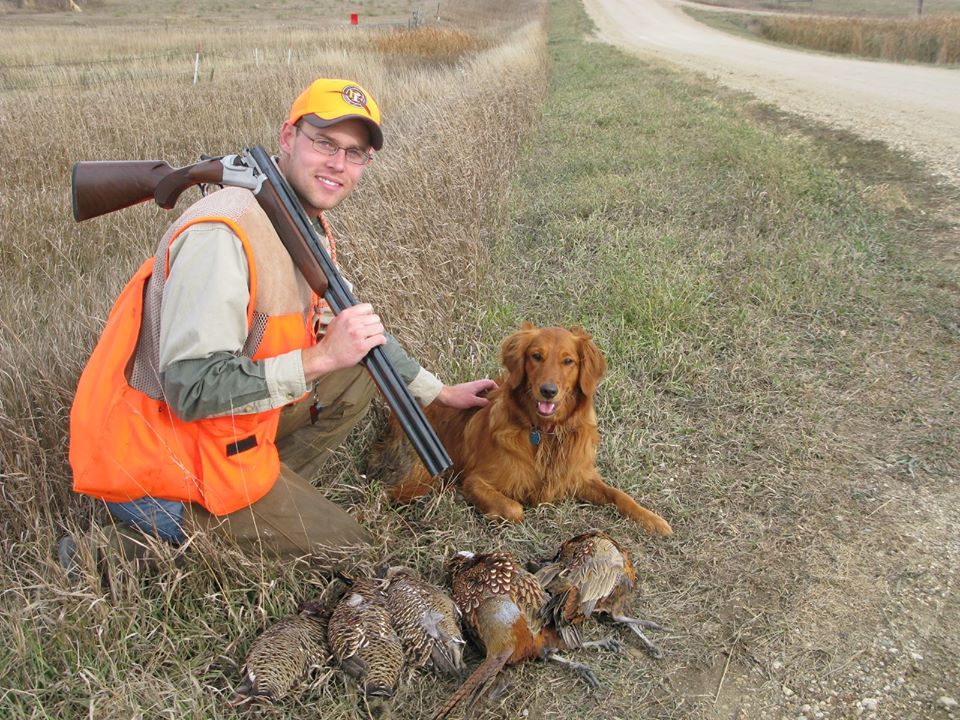
Lucy lived her life for others.  She was unselfish, loyal, appreciative, and forgiving.  That all changed as soon as she stepped into a hunting situation.   Lucy was born to chase wild pheasants, lick white bass, and stalk common carp.   She did these things to the best of her abilities each and every time we went out.  Unfortunately, this was also when her selfish ways would sometimes become apparent. It was a strange infraction of obedience completely outside her character.  When this dog caught wind of any pheasant within a quarter mile of our location, she became deaf to the world around her.   Her agility and quickness, even as an old dog, often frustrated me, but so much about what she did made me love the hell out of her.  It brought me back to keeping pace with Indiana in the switchgrass and why I wanted a dog like her in the first place.  She gave me the ability to step into a piece of public hunting land and just follow her to where the pheasants would be, watching that tail the entire time.  On our daily walks along the Missouri River, she would always look back to make sure I was still following behind (one sign of a very good dog).  But when there was a bird somewhere in front of this dog, she didn’t care if I was behind her or not.  The end goal was finding that bird no matter what!  It wasn’t uncommon for me to lag behind, or for the bird to run along tire tracks.  Yelling, whistles, and shock collars were all powerless to that pup's pursuit.  As frustrating as it was at times, it is what I signed up for.  It is what I appreciated so much about her.  Zig-zagging with her in a field would often elicit fits of giggling and watery eyes because of the insanity of it all.  We could run all over a section of CRP before flushing one rooster, or worse yet...a hen.  “Find HIM!” I would remind her during our breath-catching break in the grass.  When it worked, it was a thing of beauty.  When it didn’t, I wanted to pack up the gun and go home.  I regret each time I lost my temper with her after forgetting that she was bred for that specific purpose.  It was her job to find pheasants.  I would forget how much I loved watching her work when my errant focus was directed at bagging the daily limit.  She always worked so hard, and loved every second of it.  


There were many moments where her performance deserved so much more recognition that she actually received.  Fly fishing author Dan Frasier and photography guru Mike Dvorak (along with his dog Moose) and I were walking a game production area north of Canning one cool fall day.  I had seen many birds in that spot before, but on that particular day they were nowhere to be found.  Lucy got birdy partway through our walk and trailed the bird into a small drainage ditch full of cattails.  I hustled up an embankment to find where Lucy had jumped in just in time to see the rooster flush from the center of the ditch.  The boom from my over-under heralded success, and I thought that bird was done.  When we got over to where he landed, that rooster was gone!  Mike brought Moose over to help find a scent, but both dogs were coming up empty.  After many minutes of searching, we decided to get back to walking.  This particular hunting area is within an old army corps of engineers basin.  Imagine the contour like a giant M, with fence lines along the north and south sides and plateaus at the peaks and troughs roughly 25 yards wide.  We were walking in the middle trough when Lucy picked up a bird's scent.  Nose to the ground and tail helicoptering nearly to liftoff, she elegantly danced and spun along this bird's trail like it was the nutcracker.  First we went up to the top of the plateau, then we went back down to the trough.  I followed her to the other side where she proceeded again to run up the hill and chase this invisible bird along the north side plateau.  Finally, she ran down the hill to the outside fence line and sprinted back toward where we had come.  I was exhausted!  I could not run any more.  I stood halfway down the hill watching that dog sprint along the fence wondering when the hell she was going to stop.  And then, out of nowhere, this rooster jumps straight in the air narrowly avoiding a white-faced golden jumping just behind.  When I got to the scene Lucy was laying on top of this prefontaine wannabe rooster.  Dan and Mike gave us a well deserved break when we made it back to where they were waiting.  I set the bird on the ground and Lucy reclaimed her prize.  She rested one proud paw over that bird, and gave us the look that it was hers to keep.  


There were tough days too.  I tried hunting her in groups and regretted it every time out.  That was just not our style of hunting.  Especially the slow, methodical group drives.  Lucy would get on a bird and I would be right behind her while everyone else just sat and watched in disbelief.  It was a bit embarrassing at the time, but I was proud of her after.  She was always great at finding pheasants.  One of the worst hunting days of our lives was on a 60 degree day in late October 2016.  I debated whether to go fishing or hunting and decided to chase pheasants because it was Lucy’s preference.  We went east of Pierre along the river where I had seen pheasants many times in the past.  After walking a large section of spruce trees and chasing a half dozen birds into the valley, we bagan walking the thigh-high grass down.  The thought of snakes was always on my mind, so it was a bit of a coincidence that just after I was thinking about the possibility of seeing one in that tall grass, Lucy yelped and lept about two feet in the air.  She yelped again and jumped back from where she was standing.  It was then when the rattle began to buzz and my heart sank.  I called her over to me and watched as a big head rose out of the grass like a cobra climbing out of a basket.  Without thinking, I clicked off the safety of shotgun and shot the snakes head clean off.  I would never kill a snake if it was in an area void of people or animals, but my mindset was that this snake probably just turned the hourglass on my best friend's life.  The rattle had long ceased before Lucy and I started the walk back to the pickup, me trying to keep from getting birdy the entire time.  The panicked-stricken call to my vet must have been something to behold.   She met me at her office 20 minutes later with some anti-venom.   The snake had likely dry-bitten her hind leg before injecting venom into her neck with the second bite.  Lucy’s neck and face swelled up significantly and she was drooling and panting uncontrollably.  I was told that if she was not dead within 15 minutes, she would probably be ok.  I didn’t take any chances.  We administered the anti-venom and an IV for fluids before I took her home to rest.  That was one of the longest nights of my life.  I slept next to her on the floor and kept waking myself up in a panic to check if she was still alive.  Since that day, I never hunted with Lucy when the temperature was above 50 degrees.    


I believe Lucy preferred hunting, but she was absolutely a water dog at heart.  Having her by my side during fishing adventures has created more highlights to our friendship than anything else.  Her gaze while fishing was like that of a jaguar ready to pounce through the Amazon trees.  Her stance consistently stoic and by my side at all times.  I could fish with her in crystal clear Black Hills streams, on Missouri River flats, or on Ft. Pierre National Grasslands stockdams.  “Boy I wish my dog would fish with me like that,” was a common sentiment from passersby or nearby anglers.  My pride for this fishing dog was impossible to hide.  My face beamed when Lucy received recognition.  I only wish she could understand all the fuss that was made about her, and how often it came about.  We experienced a great amount of success while fishing together, too, as she accompanied me on many of my proudest angling moments.  Indelible memories mostly captured through the lens of a small video camera, always containing an image of a wet swamp collie adoring whatever catch and release bounty had been fooled that day.   When fishing was a bit slow (hey, nobody is perfect) her selfish side would return in a search of her own entertainment.  Stick gathering, carp chasing, and bird finding missions fulfilled her everlasting lust for adventure.  When a fish came to hand, though, it was everything she could do to monitor it, give it a few licks, and gracefully swim along after it tail-kicked back into the depths.  She was always my favorite fishing buddy.  Our adventures were typically solitary, which suited us just fine.  Her friendship and loyalty in the field and on the water were second to none.  She always wanted to go, and was up for anything we ever did.  Everyone deserves a friend like that.  


All Good Things


So many other great things about Lucy simply deserve a reference if not described in great detail: 


  • She loved our mail carriers (especially Les Cummings) and always met them out at the mailbox to say hello (and to get a few well deserved treats).  She loved going through the bank teller drive through as well.  


  • She always had to carry a glove back to the house during winter walks.  It was how she suggested it was time to return home.  During the warm-weather months, a big stick (the bigger, the better) was proudly hauled back from the river.  “Another one for the woodpile,” I would say to curious passersby.
  • She tolerated the children and even grew to love them very much.  Through all the climbing, riding, tail pulling, ear flapping, treat teasing moments, Lucy was the greatest family dog anyone could hope for.  And they loved her dearly.


  • Her independence was a breath of fresh air, appreciated more each time a needy dog came to visit.  She loved sitting outside under her tree or lounging by the couch whether or not a human was there to shower her with attention.  She was content with her alone time, and I appreciated her for that.   


  • She would offer a genuine smile (like the dragon in “How to Train Your Dragon 1”) nearly every time you returned home. She would always find a sock or stray pair of underwear to retrieve when she was excited to see someone.  It was always a surprise to find out what she came up with! 

  • Lucy was always happy to see you, whether you had been gone for five minutes or five days.  

  • She relished new snow and fresh green grass.  Her rolling sessions in each brought us both so much joy! 


  • Her bathroom etiquette was pure.  While other dogs would leave their steaming piles all over the trail, Lucy was much more polite.  She would sneak into the trees or tall grass to find a relatively private place to relieve herself before puppy bounding back to the trail in celebration of her accomplishment.  Such a polite dog.  She did make me pick up after her on many occasions, but such is life with a dog.     

  • Casting practice in the backyard or at fishing events always sparked fits of laughter while Lucy bounded after whatever hookless piece of fishing gear being dragged across the grass.  Her perked up ears and puppy-like demeanor emitted cuteness in massive quantities and made my heart expand with feels.  

  • Her dinner request always made us laugh.  Tap dancing on the floor before throwing her head up in the air as if to say, “get your ass up and feed me already!”  An occasional growl let you know she really meant business.  This is normally when we would make our feeble attempts to elicit a special bark.   

  • She loved the water so much.  I loved swimming out on Lake Oahe and turning around to see her hurrying behind.  Her look of concern made me feel that she was always looking out for me.  She enjoyed chasing her Dora the Explorer foam swim aid float that she so loved chewing on and bounding about with in the sand.  Water time always brought out the puppy in her, no matter how old she got.  After shaking the cold, clean water from her fur, she proceeded to dig a small pit in the sand and roll around in it as much as possible.  Patting her hind end during this charade sparked even more kicking and nose digging.  We took her swimming on her last day and it made my heart hurt to see her having so much fun.  It made me want to keep her forever.  That’s the power of our local water.


  • Bath times were not as appreciated as her voluntary waterdog lifestyle, but she was always such a good girl when getting cleaned up.  Not all dogs are so patient and willing to be hosed down after a beach day.  

  • She loved diving in the water for rocks.  Our veterinarian warned us early on about the possibility of injury, but it was impossible to resist.  She loved it more than anything else, and so did other beach-goers.  “Want to see a cool trick?” I’d say to kids playing on the beach.  After throwing one rock and watching her submerged nose sniff it out, they all wanted to watch her do it again!  She never broke any teeth, but did acquire multiple ear infections from water remaining in her ears.  Not fun for anyone!


  • Lucy had an infatuation with rawhide chewies…and it was adorable.  I loved wrestling with her while holding the chewy in a secret location for her to sniff out.  Cheap entertainment for both family and pup.


  • Her sweet gray face.  I like to believe that a well loved dog with a gray face only offers evidence of how many great memories were made together.  One amazing memory for every gray hair adds up to more than I am willing to calculate.  Each individually important, and together, overwhelmingly cherished. 


  • Her white teeth.  I loved making her show her pearly whites while we wrestled and played.  It would always make me laugh to see something so kind look so vicious!


  • Her propensity to expel noxious gas almost every time I would aggressively give her belly rubs.  Of course, I was constantly blamed for this indiscretion and never felt sorry for my actions.  

  • Her fur makes great fly tying material!  I’ve caught multiple fresh and saltwater species on flies comprised of Lucy fur.  

  • The willingness to sit with me in a quiet place and just spend time together.  It was one of our favorite things to do on walks or outdoor adventures.  She was always by my side, no matter what!


  • While most dogs would devour an abandoned dinner plate during a picnic movie dinner, Lucy would sit nearby and simply stare at it.  She would never take food from a plate or counter without it first being given to her.  


  • She never licked people.  She always had a sixth sense for the boundaries of others and made a genuine effort to respect them.

  • Lucy developed the amazing habit of lying down on the trail when walkers or bikers would approach.  

  • Her snuggles were like big, warm hugs.  It can only be understood if experienced.  She always seemed so empathetic and understanding of your concerns or problems.


  • She loved sleeping in mom and dad’s bed when she was able to make the jump.  It was always comforting to have her resting near our feet.   

  • Tug-of-war towel battles of biblical proportions would ensue at the culmination of baths or beach days.  She usually won!

  • Lucy never made us feel like she needed a collar or leash.  So well behaved on our walks!   


All pet owners come to a realization during our times with best friends that it will all eventually come to an end.  It is often said out loud without full comprehension of how that moment will truly make us feel.  “The hardest thing about having a pet is saying goodbye.”  It is easily said with a straight emotionless face when not staring it directly in the eyes.  This puppy biography was a testament to one of the greatest beings to have ever walked this earth.  To all who read this rendition of a life well spent, it is meant as an introduction to one of the greatest dogs known to mankind.  In turn, all who browse this piece of literature will become better human beings because of this brief connection with a dog.  A dog that made this world a better place each and every day she was a part of it.  Lucy’s legacy will live on through all of us who have had a connection to her (including you at this moment in time).  You will share this story with others who will get to know the best dog on the planet, and the world will become a better place because of it.  How can a dog have so much influence on a person?  It is because her intentions were always pure, her spirit always bright, and her love ever-present.  I miss my best friend more than words can describe.  My heart hurts so badly, but I am forever grateful for the time we spent together, for all the people who filled her life with love, and for you having this opportunity to know how much she meant to so many.  Carry Lucy’s legacy in your heart, and do as she did...make the world a better place each and every day you are lucky enough to walk on it.  And go snuggle with your favorite four-legged friends while you have the chance.  Please don’t take them for granted.  


Saturday, December 4, 2021

Driftless Blue Lines


A conversation I had the evening prior with Stephen Wisner, owner of Eau Claire Anglers, reverberated in my head like a ringing bell.

“I just think people should have the experience,” he said.  “I found those spots, and it was really cool. And somebody else is going to find them, and they are going to have a really unique experience.”

I was driving a winding road through brown trout colored trees on a cloudy October afternoon.  The rain had been falling for three days and rivers were high. I was in a remote location and an unfamiliar state…a place I would have never found without a fishing suggestion from a friend.  But Stephen’s words were still in my head.  I agreed with him 100%. 

The excitement and anticipation that comes along with exploring new water is second to very few things. Finding and catching fish within, what only existed before as a blue line on a map, can bring a satisfaction that will move grown anglers to tears of joy.  Would that sense of anticipation and satisfaction be diminished with accompanying directions? Like an open book test, does the satisfaction of an A+ compare to one that has come with an impassioned and dedicated effort without said textbook?

I pulled into the driveway of a local organization and drove around to the back of the building.  The sun’s glow behind overcast skies was decreasing by the minute, along with it...my fishing time.  Waders, boots, slingpack, and my new St. Croix 4 wt came together in haste before long strides carried me toward the sound of rushing water.  I did a 180 degree turn after a quick fall/winter revelation. Dry hands = warm hands. I draped a towel over my slingpack of essentials.

The water was rushing in a rusty brown color.  White foam piled up in seams and eddies indicating the flows force.  Matted down foliage acted similar to chalk at a crime scene highlighting evidence of the waters presence just hours before.  With the clock ticking on this new fishing hole, I tied on my favorite winter streamer in hopes of triggering a few instinctive strikes.  “If they are going to eat, they’ll eat this,” I thought while sliding down the muddy slope to the water’s edge. For a moment, I just stood and enjoyed the atmosphere, checking boxes off the “great fishing holes” attribute checklist.  I could already tell this was a special place to many.

Three long strips off the kingfisher fly reel relinquished just enough line to do the trick.  A half-hearted upstream presentation quickly drifted towards the edge of a bankside seam. Short strips made the streamer dance about 12 inches under the surface, just barely visible from my casting area.  The first cast hung near the seam for only a few seconds before a solitary tug gave way to the thumping head shake of a 12 inch brown trout. This particular fish was a perfect template for the fall colors blossoming all around me.  Futility met two impassioned leaping attempts at dislodging the barbless fly, and the fish gently glided into the rubber mesh of my long-handle net. Catching a fish in questionable conditions was fulfilling and unanticipated. Catching a fish on the first cast...prompted an obligatory celebration with myself.  Fist pump!

Four fish found my streamer in seam one, two more fell for it in seam two.  With the clock ticking, It was time to move upstream. The walk through brush and trees made my heart and belly flutter.  Being in the wilderness can do this to people. This is the feeling you seek when on blue-line exploratory missions. I perched atop a large rock at the head of a pool and presented downstream.  A flash of red was all I had seen before my rod bent under the pressure of another fish. This time, another species. My barbless hook allowed for a quick release of a fish that was too beautiful to describe with words.  Like my favorite natural wonders, I could see a million brook trout and not grow tired of the view. Autumn brookies always inspire audible expressions of surprise and wonder. This fish, and the next, made me sit back and wonder why I was so lucky.  Then, it was something else Stephen had said the day before that helped me come to grips with the satisfaction I was beginning to feel deep down inside my fishing bones.

“Then, you have someone who grows to trust you enough who would say, ‘hey, I’m going to show you something’,” he said.  “That’s different than ‘go to this spot’. Someone takes you under their wing and shows you their stuff...that’s cool to me.”  

Location is everything in the fishing world.  Hero shots and grip-n-grins are taking over as insta-famous wannabes continue to sprout out of the woodwork.  Like creeping jenny in a tomato garden, these photos and posts can draw us in with their beauty, while slowly and painfully killing off a great fishing location.  Some bodies of water can only take so much pressure. Fish, can only take so much pressure before things begin to change. Especially when talking trout. The stakes change along with the volatility of the resource.  

I understand the feeling of accomplishment that comes along with landing a beautiful fish in a beautiful location.  I understand preserving that moment in time can bring stream-cred, partnerships, speaking gigs, and pro staff contracts any professional angler dreams about. It also brings attention.  Word will get out, and anglers will take notice. You want a fishing spot to change in a hurry? Post a hero shot all over social media.

Each seam held fish willing to attack the flashy fly.  The “just one more fish” mantra was spoken many times before artificial light was required to help me slip and stumble my way back to the truck.  The flutter in my belly was still present prompting a howl that echoed through the valley and over the hillside. For me, the excitement and anticipation that came along with exploring this special place was not diminished by the fact that I was given directions by a friend.  I would never have found it on my own, and felt humbled to be trusted with the valuable information.

Our quest for the unexpected and surprising, and any ensuing success, can elicit emotions that are almost too powerful to contain.  Social media hero shots have provided an outlet for many enthusiasts experiencing this good fortune. I was trusted enough to be guided to this special location, and to a special fishing experience.  Writing...is my way of expressing these emotions. Both outlets share similar purposes, but not always a similar impact. Taking care of our resources involves more than just conservation and preservation.  An accountable approach to its utilization and the ceremonial celebration should be considered first and foremost. Treat nature like you would a good friend who has entrusted you with a new fishing spot. The future of our resources depends on it.

Wednesday, November 24, 2021

The Rise of the Dodo


“Game management is the art of making the land produce a sustained annual yield of game for sport hunting and other recreational enjoyment.”  - Aldo Leopold


He set his mickey mouse alarm clock for 5:00 a.m.  The internal moshpit of butterflies had already begun.  For this little boy, a full REM cycle would not be achieved on that night.  While staring into the darkness of his basement bedroom, thoughts of pheasant hunting glory ran through his head like microfilm through a viewing machine. Triumphant hunting stories of biblical proportions had already set that child’s expectations above any ideas of aspiration.  The next morning would bring his first pheasant hunting adventure with the adults.  


The 20 gauge pump shotgun had only shot milk jugs until that moment.  He was walking around a stock dam on the edge of a cattail patch when the biggest wild cock-bird pheasant flushed just ahead.  Its tail feathers wafted through the air, as if in slow motion and 4K.  In a flash, he could see it land hard through the emerging barrel smoke.  The first South Dakota ringed-neck rooster, and a memory that was added to the vault under armed guard.  Many more memories exist from those early years.  Hundreds upon hundreds of birds flushing from so many different locations that anyone seeing it would be frozen solid in an awe-struck coma.  Road hunting adventures where sharp eyes were prized, and speed (always coupled with safety) was a priority.  My birthday landing on/around opening weekend didn’t hurt.  Parties came complete with home-cooked chicken and dumplings, sweet corn, and chocolate cake to wash it all down.  The traditions, friends, and family have made pheasant hunting special to me.  But it began with the birds.  I was a part of, what I thought, were the glory days of pheasant hunting in South Dakota.  


Back in the early 1990’s, though, adults spoke longingly about how good things used to be.  My recollection of their rationale evades me still today, but I remember wondering how it could have been any better than it was.  The Pittman-Robertson Act (Federal Aid in Wildlife Restoration Act) of 1937 came at a time when wildlife populations were being decimated across the country.  Taxes from firearm and ammo sales are gathered each year for the sole purpose of conservation and education.  Since inception, over $198 Million has been awarded to the South Dakota Game, Fish & Parks, and the funding continues to offer $10’s of millions for such programs each year.   That provided, and still provides a much needed jolt to our wildlife and their habitats!  My family members were most likely lamenting about the days of the Conservation Reserve Soil Bank Cropland Retirement Program (1958 - 1963).  With 1.8 Million acres of unbelievable year-round cover for pheasants, the population skyrocketed from an estimated 6 million birds, to over 11.1 million!  Birds and other wildlife were flourishing again in the 1990’s.  Fishing was good, too.  Growing up with this in my backyard was, and always will be, special to me.  South Dakota was an outdoor enthusiasts paradise.  People flocked to the Rushmore State to fish and hunt without the allure of enticing brood survey numbers or fancy marketing messages.  Unfortunately, like a restaurant with horrible food, it matters not how clever your messaging strategies, or how many impressions your marketing efforts generate.  If customers (hunters) come in and have a horrible experience, they’re not coming back.  And...they’re telling their friends.  Birds have always brought business to South Dakota.  But it seems that nobody ever dared to wonder what would happen if that were not the case.  Changing priorities have altered the entire dynamic that exists in South Dakota.  And now, we’re reeling.    


Removing the brood survey was not the beginning of the change, but indicative of the direction  state leaders wished to go with messaging.  Brood numbers have not been as good as they were in the past, so rather than utilize this number as an indicator of management needs and locations for focus, they swept them under the rug and began filling the hole with marketing dollars from the tourism office. Business owners and regional tourism representatives miss those brood surveys.  Good, bad, or otherwise, they were a talking point.  A reason for people to get excited about pheasant hunting in South Dakota.  And it was a way to count WILD birds.  With brood surveys being a thing of the past, Game, Fish and Parks is left guessing about management strategies and where they are needed most.  In their place, headlines and outlined speaking points regurgitated by lead government officials to a general hunting public with waning interest.   


“We’re still better than Iowa” and “Even when it’s bad in South Dakota, it’s still pretty good”.  This is what we tell ourselves and others at the request of state government entities and tourism offices when things get bad.  For good reason...this is big business in South Dakota.  An estimated $218 million worth of economic impact came into our state in 2018 alone.  License sales support outdoor education, habitat development, and public land acquisition.  Grocery stores, gas stations, hotels, local restaurants and all other local shops benefit from eager hunters visiting our towns.  We need people to chase pheasants here.   I was once a part of the propaganda.  As an outdoor communicator for the office of tourism, I jackhammered speaking points for newspaper and radio interviews.  South Dakota Game, Fish and Parks brood surveys were once touted as the farmers almanac of hunting forecasts and I used them with reckless abandon.  When one is working behind the scenes, humility quickly finds a way into their mentality.  My mindset changed from one of pride and excitement for a state and her resources, to shame and disappointment.  I remember the first hunt I organized for outdoor media and when I began to recognize the need for transparency and a bit of skepticism in the industry.  I was working with Field & Stream magazine to host outdoor communicators and industry representatives to a wild prairie bird hunt in central South Dakota.  We were chasing sharptails and pheasants on two different properties.  These folks wanted to shoot wild birds in South Dakota and share those experiences with their readers.  I partnered with an outfit south of Presho, S.D. touting 100% wild birds and a genuine South Dakota hunting experience.  The first walk brought many birds to the sky, and many birds to hand.  These hunters certainly knew how to put a bead on a bird.  The Field & Stream guy approached me after the first walk holding three birds.  “I thought you said these were wild birds,” he said quizzically.  Upon examination, the birds had very obvious blinder holes through their nostrils, a sure sign that they spent time behind a pen.  When I first asked the owner about it, he suggested that preserve birds sometimes come to his property because of the habitat.  He later confessed to releasing “some” birds specifically for this hunt.  I was left jaded and cynical.  Private shooting preserves made a very bad first impression on me.  


The Rise of the Dodo bird


In 1963, the South Dakota legislature enacted the Private Shooting Preserve Act, authorizing the issuance of licenses to private shooting preserves.  Shooting preserves are defined as an acreage of land on which pen-raised game is released for purposes of fee hunting.  The rules are simple:  $100 bucks (plus $.40/acre) is charged to apply for a preserve license.  Anyone (including corporations) with at least 160 acres of contiguous land (touching or sharing a common border) can operate a hunting preserve in South Dakota.  The shooting preserve season runs from September 1 until March 31 of the following year during which time hunters can blast holes in the sky from sunup until sundown.  Preserve permit holders are required to release the same number of rooster pheasants (hens may also be released but will not count toward the release requirement) that are taken from the property during any given year.  Daily bird release and harvest records must be kept, with each dead bird requiring a special tag purchased from Game, Fish & Parks.  These tags are $.25 each, or $2.00 if not utilized during the season. 


Like a phoenix rising from the ashes, the dodo bird is making a comeback from extinction!  You may know these birds by a variety of commonly used names: rainbow chickens, blinder birds, or pen-raised chubsters.  Preserve hunting has become as traditional as opening weekend, and it is taking over our state.  South Dakota once boasted traditions, camaraderie, relationships, and pride.  Pheasant hunting was founded on chilled October days where landowners and friends came together to enjoy chasing a wild bird that has thrived in our state’s habitat for over 100 years.  Bagging pheasants was not only a right of passage for new hunters, but a point of pride for savvy veterans.  Pheasants were (and still are to most) famed and cherished as table fare as well.  Everyone wanted to put birds in the freezer.  These traditions, like South Dakota’s landscapes, are changing, and not for the better.  Profit margins act as catalysts for habitat being replaced by massive fields of corn.  The next generation of farmers is thinning faster than my retreating hairline.  Small farms are becoming conglomerates, closed to hunting and void of wildlife.  The ideas of getting together with family, visiting old friends on the farm, chasing wild roosters through cattail sloughs, plum thickets, and kochia weeds before enjoying a hot dish of chicken and dumplings and telling stories of past and present is becoming a thing of the past.  Today, blaze orange begins to show up in South Dakota during the dog-days of September.  It surprises me every time to find an orange clad hunter not declaring to chase sharptail grouse or prairie chickens (whose season begins mid September).  It happened again this past September.  While walking through the parking lot of our local Lynn’s Dakotamart, I passed a blaze orange clad man with two shorthairs in the back of his vehicle.  “Chasing some sharpies?” I asked with an upbeat inflection.  “Nope...Pheasants,” he replied.  “A little early for that isn’t it?” I said with a smirk.  “Not for us,” he said without looking up from his groceries with obvious intentions to avoid further conversation.  


The rise of preserve hunting is directly correlated to the demise of our wild pheasant population.  Correlation does not equal causation, but this is a topic that must be considered as a vital part of the pheasant management conversation.  Predators, nesting cover, drought, bad winters, HABITAT...all have had their place up until now.  But since 1963, not once has anyone questioned the sustainability of a program that should be self-sufficient.  Put-and-take programs may seem innocent and benign, but how are they affecting our hunting experience in South Dakota?  Are pen-raised birds a suitable substitute for their wild kin?  Preserve operators are primarily shooting birds that were released not long before the hunting began.  But these dodo-birds are not the only ones taken on preserve properties.  Sometimes two, three, and four year old rooster pheasants that have helped build a resilient population of wild birds are not being replaced by wild (or even kin of wild roosters) but rainbow chickens from the pen.  All around the country, states have tried to sustain pheasant populations with pen-raised pheasants.  Time and time again, these efforts fail due to the fragile home-raised domestic chicken blood lines.  The only proven method for establishing successful wild bird populations has been trapping and transplanting already native, wild pheasants.  In 1982, Carl Troutman wrote what amounts to be the “pheasant bible” in the book History, Ecology and Management of the Ring-necked Pheasant in South Dakota.   In it he describes in great detail management strategies used to effectively enhance the pheasant population in South Dakota.  He writes:


“Except for the success of the original stockings, subsequent programs designed to increase breeding season pheasant populations by restocking with game-farm or privately reared birds have been unsuccessful.  This holds true for the limited effort put forth in South Dakota and for all other states engaging in this management practice.”  


It goes on further to reference a 1972 study out of Minnesota which revealed the difference between survival rates of game-farm pheasants and pheasants possessing wild ancestors.  The wild birds simply know how to use habitat to stay alive longer.  When you replace a wild bird with one from a pen, you are creating a long-term hole in the population cycle.  Trout streams experience similar ecosystem changes when non-wild fish are introduced into a population of natives.  Eventually, the declining genetic strength of the hatchery fish will begin to weaken the species as a whole, creating long-term damage to the longevity of the species in that particular body of water.  Studies have shown significant improvements to fish populations and size in streams where hatchery fish were removed from the ecosystem entirely. The same might be true for pheasants as well.  


Legislation authorizing the issue of private shooting preserve permits was passed in 1963, but only between 0 and two shooting preserves existed until 1980.  That grew to 80 preserves in 1990, 150 preserves existed in the year 2000, and 225 in 2018.  Since 1992, the number of issued private shooting preserve permits has risen by 167%!  The number of birds being released and harvested has followed steadily along with that trend.  The number of birds released between 1992 and 2019 has increased by 517% (going from 80,000 to 499,000 respectively).  This number is only for private shooting preserve operators in South Dakota.  Game, Fish and Parks does not track or monitor birds released on private land, nor do they have any state-supported stocking initiatives.  The number of wild birds harvested on these preserves is difficult to analyze objectively because the numbers are reported by the preserve operators themselves.  They have no extra incentive to discern a wild bird from one that is released because the state does not recognize a difference between the two.  As it reads on the South Dakota Game, Fish and Parks website: 


“If 800 pheasants (680 marked and 120 wild) were harvested on the preserve, release records must show that at least 800 rooster pheasants have been released on the preserve acres.”


Current standards value a pen-raised dodo bird blown to smithereens at 10 yards by a green executive from down south the same as they do a 2-3 year old wild rooster pheasant that was in the wrong place at the wrong time.  The purported percentage of wild birds shot has fluctuated from 23.7% in 2010 to 8.2% last year and from 15% to 10% to 6% and elsewhere in between.  The average since 2010 is 12.6% of total killed birds on a private shooting preserve being reported as wild.  I have no confidence in this number being objective, but it is what we have to work with.  This means that nearly 37,000 wild birds were shot on shooting preserves in 2019.  Considering over 800,000 ring-necked pheasants were reportedly shot in 2019, this seems like a small margin and insignificant.  But the subjectivity of these numbers must be taken into account.  Diluting wild bird populations with pen-raised pheasants has already begun to weaken the species and affect their survivability in South Dakota’s harsh climate.  


It must also be considered that there will be pen-raised birds reported in the general numbers as well, those are not all wild birds.  Bottom line...when you are putting in nearly 500,000 glorified chickens into a system losing vital habitat structure each year, the result will be what you see today...a state struggling to reconcile what once was, and attract the savvy hunters who have decidedly chosen to venture elsewhere for their hunting experiences.  And rightfully so.  Gone are the days of memory and awe-struck coma inducing pheasant flocks.  Hunters may stomp around all day to find their three bird limit.  A Nebraska resident can do that 20 minutes from their house, why would they come all the way to South Dakota to do the same thing?    


There is one other problem with shooting preserves that is rarely discussed or given great consideration by the hunting community.  That problem is the thousands of pheasants that are left in preserve freezers each year.  I find it innately inhumane to shoot something for fun.  The thrills that come along with a hunting experience are indescribable when experienced “the right way”.   However, a hunter’s ultimate goal should never be solely to shoot and kill an animal.  That is completely sadistic and immoral.  I think back on every preserve hunting experience that has molded my concrete compass that extends well beyond the pheasant fields.  All of those times I have joined large groups of hunters (novice and experienced alike).  This has included big shot executives and their extended networks, donors and business prospects being treated to “the hunt of a lifetime”, and everyone in between.  They’ve been taken to private preservers to shoot their fill.  In 2009, Game, Fish and Parks commissioners (of which included two commissioners directly connected to preserve property, one of which rightfully abstained from the vote) voted to increase the bag limit on private preserves to 20 pheasants per day during the regular pheasant season, up from 15.  No state hunting license is required to shoot 20+ birds on a private shooting preserve, just a private preserve license that is only good on private property.  From Sept 1 - March 31, wild and pen-raised birds alike are fair game if on preserve property.  Until you’ve experienced a hunt like this, it may be difficult to contemplate.  Imagine walking in a field where recently unmasked birds strut by your side unaware of the shotgun blast that is about to decide their fate.  This is where a half-concealed kick is sometimes required from the guide's boot to get these birds to spread their wings and croak out a sickly cackle.  If they’re lucky, the birds will get blown to bits within the first 10 feet.  If not, they lose a leg, or go down without a wing.  The ones that get out unscathed are left unaware of their circumstances, environment, and how to survive in the wild.  Fewer than 10% of released pen-raised birds will live past the first week.  At the end of this “hunt” cigars are lit, beers are cracked open, high-fives fly, and a pile of hundreds...yes hundreds of dead birds remain for photos and display.  When it comes time to clean and take birds home, that’s when the room goes quiet.  “Hunters” begin kicking the ground and avoiding eye contact.  “I need to fly home tomorrow,” one will say.  “We’ve got plenty in the freezer already,” someone will chirp.  They shot their fill of “wild” South Dakota ringnecks and remain content with that.  Let the lodge figure out where to take those dead birds.  Maybe they can donate them to missionaries or food programs.  If you have experienced this, I’m sorry.  It’s not an easy situation to be a part of.  If you feel uncomfortable for having been one of those “hunters”...I hope the guilt gets the better of you.  I hope you change your ways.  Please know that this does not accurately describe every hunter to ever set foot on a preserve.  Nor does it describe every preserve hunting experience you’ll have in South Dakota.  There are mindful stewards who hunt these properties too.  And diligent property owners who have a knack for managing their land for unbelievable experiences and sustainability.  However, each and every time I’ve hunted on preserve property, there have been dead birds left on the table.  This is wrong. 


It would be unwise to omit the benefits that preserve operations bring to the state.  They allow farms and ranches another source of income during difficult months of the year.  They create opportunities for hunters, young and old, without great access to hunting opportunities or wildlife.  They have viable habitat utilized by all wildlife throughout the year.   And they do bring money into South Dakota from September - March.  These private preserves are lawfully operating under a special permit, releasing as many birds into the wild as they shoot, and bagging primarily pen-raised pheasants.  They are developing properties specifically for hunting and bringing business into South Dakota.  It sounds like a pretty good deal when you think about it.  But this is not about what’s good for us now.  It’s about what will be good for us 20 years from now.  When these hunting traditions have become memories for many, and new traditions involve other states and circumstances.  If we want pheasant hunting to be a viable business in South Dakota for the long term, we need to change our ways.  I want more from a hunting experience for someone visiting my state.  A parent taking their child pheasant hunting for the first time will not find a genuine South Dakota pheasant hunt on these preserves.  Even if they did, could they afford it?  Is that the experience we want the next generation to have in South Dakota?   We must determine what long-term goals we have for our state and her wildlife.  How do we get back to being the pheasant capital of the world?   


We need to remove the preserve program and all dodo bird stocking efforts immediately.  We need to ask how we can best revitalize habitat and farming practices to benefit wildlife and still afford the farmers a valuable living.  Finally, we need to teach our young hunters that a pheasant hunting experience is not about shooting a rainbow chicken while it obliviously struts down a row of corn.  Instead, let’s talk with our kids about how exhilarating and exhausting it can be to hunt down the resilient American ring-necked pheasant.  Not the dodo bird that exists in mass quantities today, but the cock-bird that was declared our state symbol back in 1943.  It’s about enjoying time with family before stomping into a South Dakota field with a possible jack-in-the-box surprise in every step.  We need to bring back the experiences that cause kids to lose sleep at night, but not care.  Opportunities for pheasant hunting glory.    


The priorities of South Dakota are changing.  From one of traditions, wildlife, and heritage to that of profits, efficiencies, and scalability.  It is impossible to blame a capitalistic society for “progress”... because that’s what it is all about.  But you can never give to something without taking from something else.  What we give to hunting operations, farming, ranching, and industry, we take from habitat and wildlife resilience.  As South Dakotans...hell, as outdoor enthusiasts around the world, we are settling for less.  Settling for fewer public lands, fewer education programs, and fewer funding options.  We are settling for pen-raised birds being kicked in the ass over wild South Dakota ringnecks!  This is not stipulation, but proven in the numbers.  Nearly 284,000 dodo birds were shot in South Dakota in 2019, likely many more.  There were 29 additional preserves that joined the fray in 2020, bringing our new grand total of private shooting preserves to 229.  It is strikingly apparent that we, as hunters, are conceding to contentment with shooting pen-raised pheasants.  We have rolled over and succumbed to the industry and the way they would like it to be.  When people come into South Dakota seeking a “genuine wild pheasant hunting experience” they are finding dodo birds in perfectly manicured food plots with the sole purpose of short term holding for shotgun fodder.  It’s like tying a walleye to a rockpile and coming back later to hook the line and bring the fish in.  Does that bring people joy?  How many would appreciate that experience?  How many would recommend that to their friends and colleagues?  Most importantly...how many would spend $120 on a nonresident license to experience that event?  I sure as hell wouldn’t.  And I won’t blame anyone that chooses not to.  The same way I wouldn’t recommend a hunt where kicking a bird is required to get a shot at it.  Where a pile of dead birds remains on the table at the end of the day.  Nonresident hunters are responding in-kind.  License sales have been on a down-and-up (mostly down) decline since the last time we surpassed 100,000 sold in 2010.  Licenses sold in 2019 were down 37% since that 2010 year, and showing signs of another decline in 2020 if they continue on their current path.  This is real money.  37,000 licenses at $120 each equals $4.4 million!  $4.4 million missing from the budget for land purchases, habitat projects, education programs, and qualified staff.  Millions of dollars not brought to the hunting table because South Dakota believes this is a marketing and tourism problem.  We need to face the reality that it is not.   


I believe wildlife, particularly South Dakota’s pheasant population, can again become resilient and world-class.  I believe South Dakotans and outdoor enthusiasts who appreciate this state have an important decision to make.  Do we continue to accept the declining status-quo of a South Dakota hunting experience?  Do we sit idly by and wait for government leaders to initiate measures that may or may not hit to the heart of the issue?  Or do we take a stand?  Take back our public lands, our traditions, and our hunting experiences.   We should not accept preserve hunting as the new norm.  We should demand investments in habitat development, nesting cover and regulated farming practices to accommodate it.  We should seek fewer pen-raised birds being released for put and take, and more partnerships between government and landowners to bolster living conditions for the wild ones.  Make sustainable farming and ranching practices centered around habitat and viable forms of income for those willing to be a part of it.  Bring back the traditions that we are all longing for.  Send the dodo back into extinction, and bring back the American ring-necked rooster.  It’s time to make pheasant hunting great again in South Dakota.